

The AI, Cloud, Cybersecurity Flywheel: A Self-reinforcing Infrastructure Loop
This isn’t a tech stack. It’s a loop, and it’s accelerating

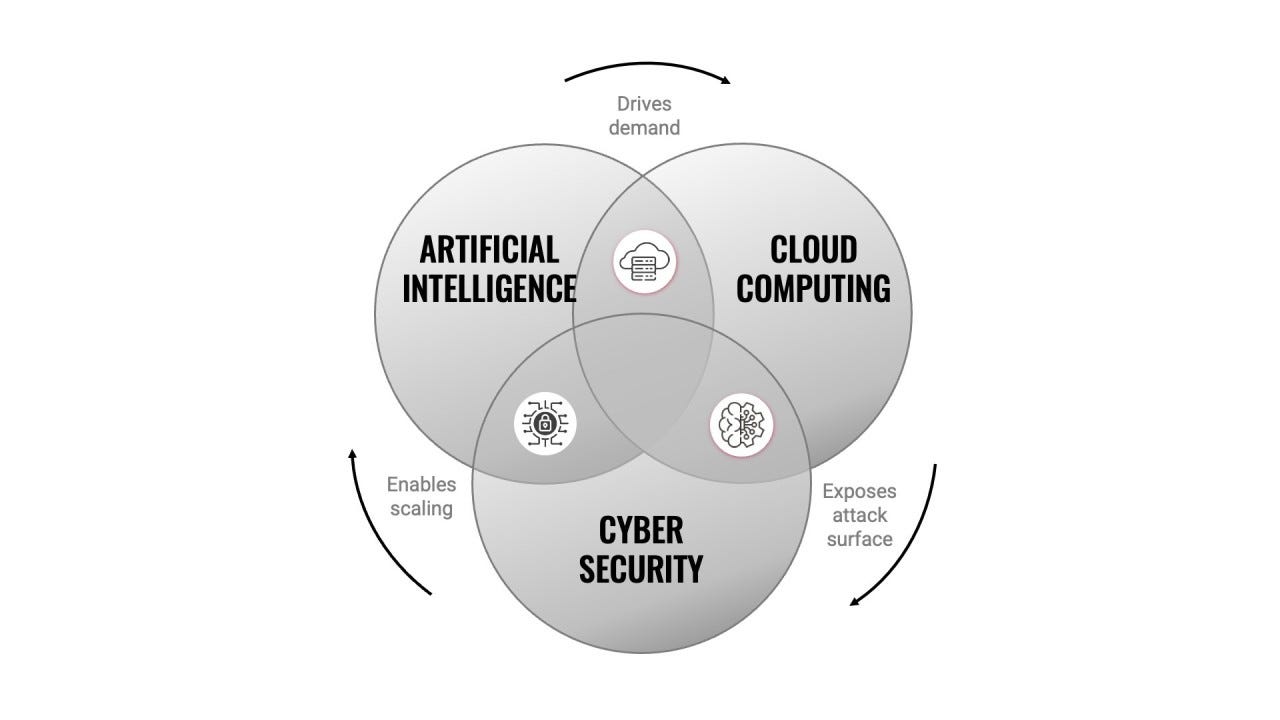
Lately, I’ve been making the case that cloud infrastructure, AI, and cybersecurity have moved past being “tech trends.” They should be considered as structural drivers of macro and geopolitics, but their real power lies in how they reinforce one another.
This isn’t a tech stack. It’s a loop, and it’s accelerating.
🔁 AI → Drives Cloud Demand
Foundation models and AI agents require massive compute and dynamic scaling.
Compute requirements push sustained demand for GPU-rich, AI-optimized cloud infrastructure.
☁️ Cloud Infrastructure → Requires Robust Cyber Defense
As critical infrastructure migrates to the cloud, risk factors multiply. More data, endpoints, and APIs mean more vectors to defend.
🤖 Cybersecurity → Must Become AI-Native
AI models themselves are vast attack surfaces. Cybercriminals, including state actors, use AI to scale and personalize attacks - a trend that will not slow down any time soon. Legacy tools can't keep up. Cyber defense systems must be AI-powered and automated, with real-time detection, response, and remediation.
📈 The Loop Accelerates
AI adoption → cloud dependency ↑
Cloud scale → attack surface ↑
Threats evolve → AI-powered defense requirements ↑
Stronger defenses allow for safe (or, safer) scaling of AI and cloud infrastructure.
🔐 Cybersecurity anchors
We back several companies that use AI to secure infrastructure, code, and data.
• Cyngular Security provides AI-powered cloud investigation and response automation that empowers security teams to identify, investigate and eliminate threats in cloud environments.
• Acsense IAM Resilience Platform eliminates IAM as a single point of failure, reducing downtime and associated costs, while actively ensuring data security, continuity, and compliance readiness.
• Shield-IoT is an AI-powered SaaS platform securing mass-scale, out-of-perimeter IoT networks, providing businesses with visibility, threat management and compliance for their cellular-connected devices.
• Brinker provides active detection, take-down and counter-narrative defense against weaponized disinformation, including influence campaigns and disinformation attacks.
• LuminAI Security embodies the thesis that AI models must be protected against AI-driven malicious intrusion by providing security at the model level.
☁️ Cloud Enablers
These startups build and/or optimize the infrastructure layer that powers AI deployment and security operations.
• Chronom is a cloud observability platform that optimizes cloud infrastructure in terms of operational stability, security and efficiency.
• Boost.space is a cutting-edge modular integration platform for business data systems that serves as a data unification layer. It enables AI models to access, learn from, and act on clean, structured cloud-based data across fragmented tools.
🤖 AI Drivers
These companies develop and apply AI to generate productivity gains and intelligence.
• Hirundo is an AI un-learning platform that makes sure AI only knows what it should by removing unwanted data and behaviors from AI models.
• WeCheck.ai is an AI private investigator analyzing personal digital footprints and delivering risk and compliance insights for organizations.
• Langware.ai is an AI-powered coding agent - always connected to architecture, requirements, docs, tasks, and meeting notes - that supercharges SW development.
🧠 Synthesis: Reinforcement in Motion
Each company plays a role in the loop:
• AI companies drive demand for elastic, scalable infrastructure
• Cloud enablers make that scale operationally viable
• Cybersecurity players secure the loop through AI itself
Together, they form more than just a diversified portfolio - they create a defensible, interdependent ecosystem. They don’t just benefit from the AI-cloud-cyber flywheel, they turn it.
Investors Takeaway
This is not about picking one vertical. It’s about understanding a self-reinforcing cycle that underpins the digital infrastructure driving the modern economy.
Investors allocating capital across cloud infrastructure, AI platforms, and cybersecurity automation are not “trend chasing.” Far from it. They’re positioning themselves at the intersection of structural demand, national security, and enterprise resilience. This is not a far-flung, theoretical line of thinking, it’s real right now, and it’s only going to accelerate.
👉 If this resonates, subscribe for more insights on where tech, capital, and geopolitics intersect. And if you’re curious about digging deeper into Israeli deep tech, let’s connect.